

Episiotomy Scar Care:
A Guide to Healing
Breaking down and softening episiotomy scar tissue involves gentle, consistent perineal scar massage after your wounds have fully healed and you receive clearance from your doctor, typically around 6 to 8 weeks postpartum. This technique helps mobilize tight tissue, increase elasticity, and reduce pain during daily movement or intimacy.
Why This Matters
Scar tissue heals differently than the surrounding tissue. Left alone, it can become tight, less elastic, and adhere to nearby layers. This affects more than just comfort.
- Pelvic floor function. Restricted, tethered tissue can limit how well your pelvic floor muscles lengthen and contract, which plays into bladder and bowel control, core support, and overall pelvic floor coordination.
- Pain and sensation. Unaddressed scar tissue is a common contributor to pain with sitting, exercise, or intimacy long after the wound has closed.
- Future births. Elastic, mobile scar tissue is better able to stretch during a future vaginal delivery. Tight, inelastic scar tissue is more likely to tear again along the same line, since scar tissue does not stretch as well as your body's original tissue. Massage helps improve pliability, which may reduce, though not eliminate, the risk of re-tearing in a subsequent birth.
This is why scar massage is worth prioritizing, even once the area looks healed on the outside.
Before You Begin
- Do not start massage until you have been cleared by your OB or midwife, and your wound is fully closed.
- Avoid starting if you notice any signs of infection, including redness, swelling, warmth, unusual discharge, or fever.
Preparing For Massage
- Wash your hands thoroughly with soap and water.
- Find a comfortable position, such as semi-reclined with pillows, or standing with one foot raised on a chair or the edge of the tub.
- Use a clean, water-based personal lubricant or natural oil, like coconut or olive oil, to reduce friction.
- Warm up the area first with a warm bath or shower if desired.
What Scar Tissue Feels Like
Healthy tissue is soft, stretchy, and slides easily under your fingers. Scar tissue often feels different. Here is what to expect.
- Ropey or corded, like a thin band or string under the skin.
- Raised or bumpy, a small ridge instead of smooth, flat skin.
- Stuck or tethered, the skin does not glide, it pulls or tugs when you try to move it side to side.
- Numb or overly sensitive, some areas may feel like nothing is there, while others feel tender or zingy to light touch.
- A tight band or pulling sensation, especially noticeable with stretching, sitting, or intimacy.
None of this means something is wrong. It is just what healing tissue feels like before it has been mobilized. The goal of massage is to gradually make that area feel more like the surrounding tissue: soft, mobile, and less noticeable.
Step By Step Massage Techniques
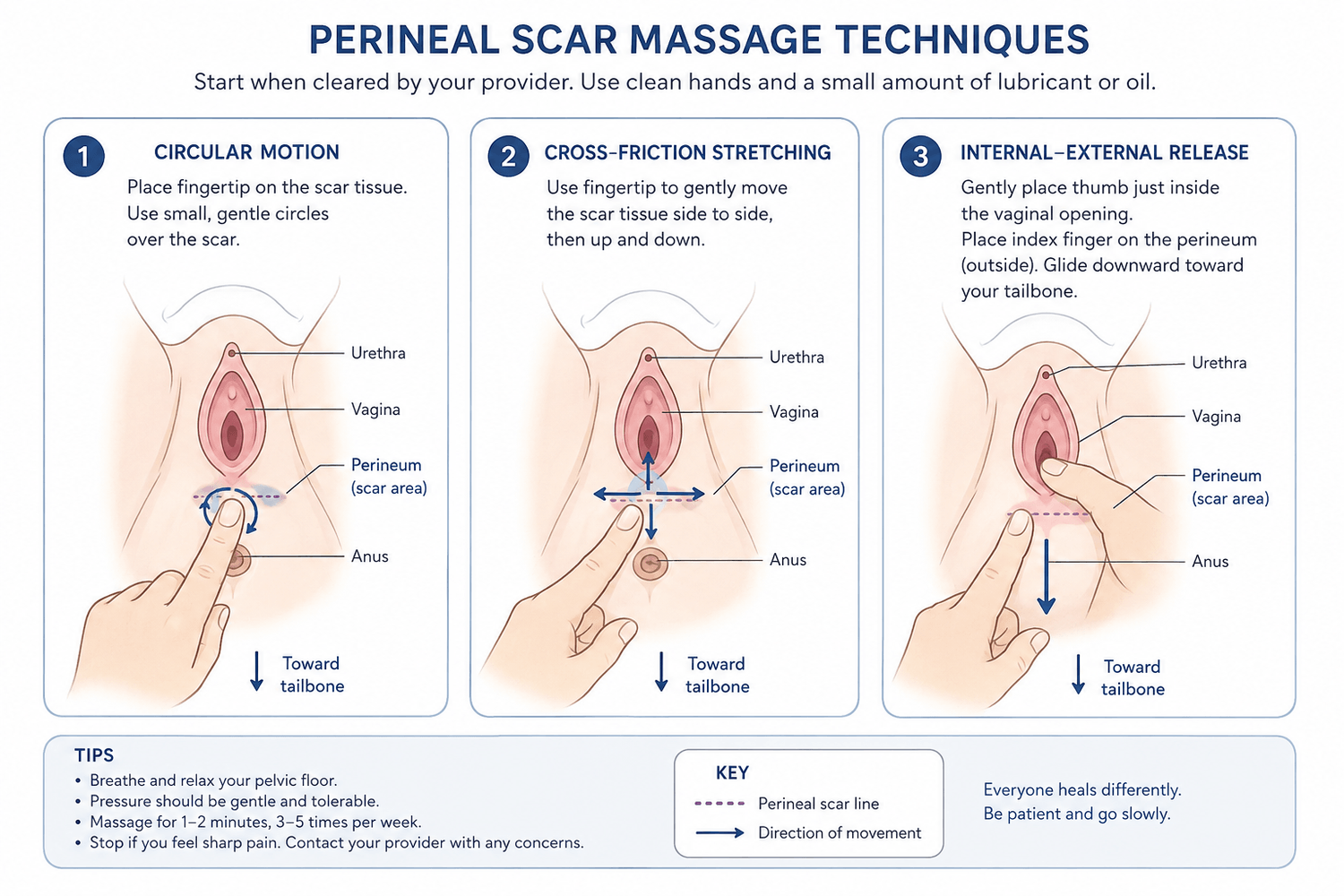
- External touch. Begin by gently touching the skin around the scar to desensitize the area before applying deeper pressure.
- Circular motions. Place a clean finger or thumb on the scar tissue and move in small circles, gradually working along the length of the scar.
- Cross friction stretching. Move the skin gently side to side and up and down across the scar line.
- Internal external release. If comfortable and healed internally, place your thumb just inside the lower part of the vaginal opening, pointing toward the rectum, and your index finger outside. Apply gentle, steady pressure, pressing downward toward the tailbone, for 30 to 60 seconds until you feel the tissue relax.
- Pressure level. Aim for a mild stretching sensation or light discomfort, around a 3 or 4 out of 10. Stop immediately if you feel sharp or severe pain.
- Breathing. Keep your breath slow and relaxed throughout. Exhale as you apply pressure or stretch, holding your breath will only increase tension.
Scar Mapping
As you massage, gently notice and mentally note:
- Areas that feel numb, overly sensitive, tight, or painful.
- Spots where you feel pulling or restriction during movement, sitting, or intimacy.
This is not something you need to fix yourself. It is useful information to share with a pelvic floor physical therapist if you decide to see one.
Routine
- Spend about 5 to 10 minutes, 2 to 3 times a week, performing the massage.
- Stop immediately and call your provider if you notice increased redness, swelling, bleeding, warmth, or unusual discharge.
Realistic Timeline
Healing is not linear, and results build gradually.
Consistency matters more than intensity. Little and often beats occasional deep sessions.
Professional Support
Consider seeing a local pelvic floor physical therapist for targeted, hands on scar tissue mobilization and specialized guidance, especially if you are not noticing improvement, or have significant pain, numbness, or tightness.
Have Questions, Or Not Sure Where To Start?
Healing looks different for everyone, and you do not have to figure it out alone.
Created by Get The Tech Out Of Here with Systeme.io